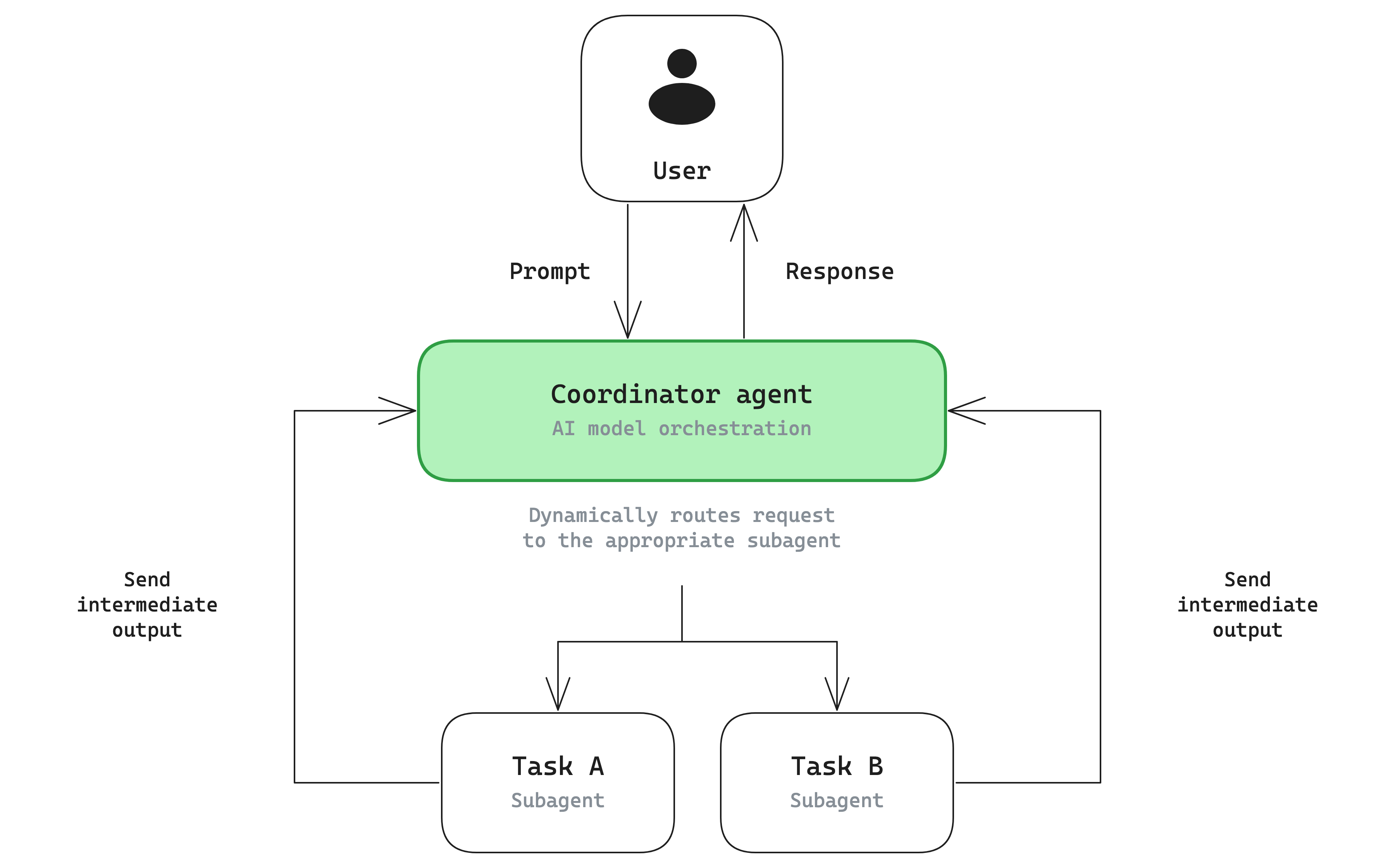
The multi-agent coordinator pattern uses a central agent — the coordinator — to direct a workflow.1 The coordinator analyzes and decomposes a user’s request into sub-tasks, then dispatches each sub-task to a specialized agent for execution. Each specialized agent is an expert in a specific function, such as querying a database or calling an API.
Diagram
Open the interactive version here to pan and zoom.
The distinction that matters
The coordinator uses an AI model to orchestrate and dynamically route tasks. That is the line between this pattern and the code-driven workflow patterns: the parallel pattern dispatches tasks for simultaneous execution through a hardcoded workflow, with no model orchestration involved. Here, routing is a reasoning decision made fresh at runtime.
When to use it
Use it to automate structured business processes that require adaptive routing. The source’s example: a customer service agent acts as the coordinator, analyzing an incoming request to determine whether it’s an order status request, a product return, or a refund request, and routing to the appropriate specialized agent based on that determination.
From the pattern-comparison guidance, the workload profile is:
- dynamic routing to an appropriate specialized subagent for structured tasks with varied input,
- tolerance for high latency, caused by the repeated calls to the coordinator model that direct tasks to the right subagent,
- tolerance for the cost those repeated coordinator calls incur.
Trade-offs
More flexible than rigid, predefined workflows. Because a model does the routing, the coordinator handles a wider variety of inputs and can adapt the workflow at runtime.
The cost follows directly from that: the coordinator and each specialized agent all rely on a model for reasoning, so the pattern makes more model calls than a single-agent system. The reasoning quality can be higher, but token throughput, operational cost, and overall latency all increase.
Going deeper
Hierarchical task decomposition is the coordinator pattern applied recursively — coordinators delegating to coordinators, several layers deep.
Footnotes
-
Samantha He, “Choose a design pattern for your agentic AI system”, Google Cloud Architecture Center, last reviewed 2026-05-28. Local copy:
references/google-cloud-agentic-design-patterns.md. ↩