In the multi-agent parallel pattern — also called the concurrent pattern — multiple specialized subagents perform a task or sub-tasks independently at the same time, and their outputs are then synthesized into a final consolidated response.1
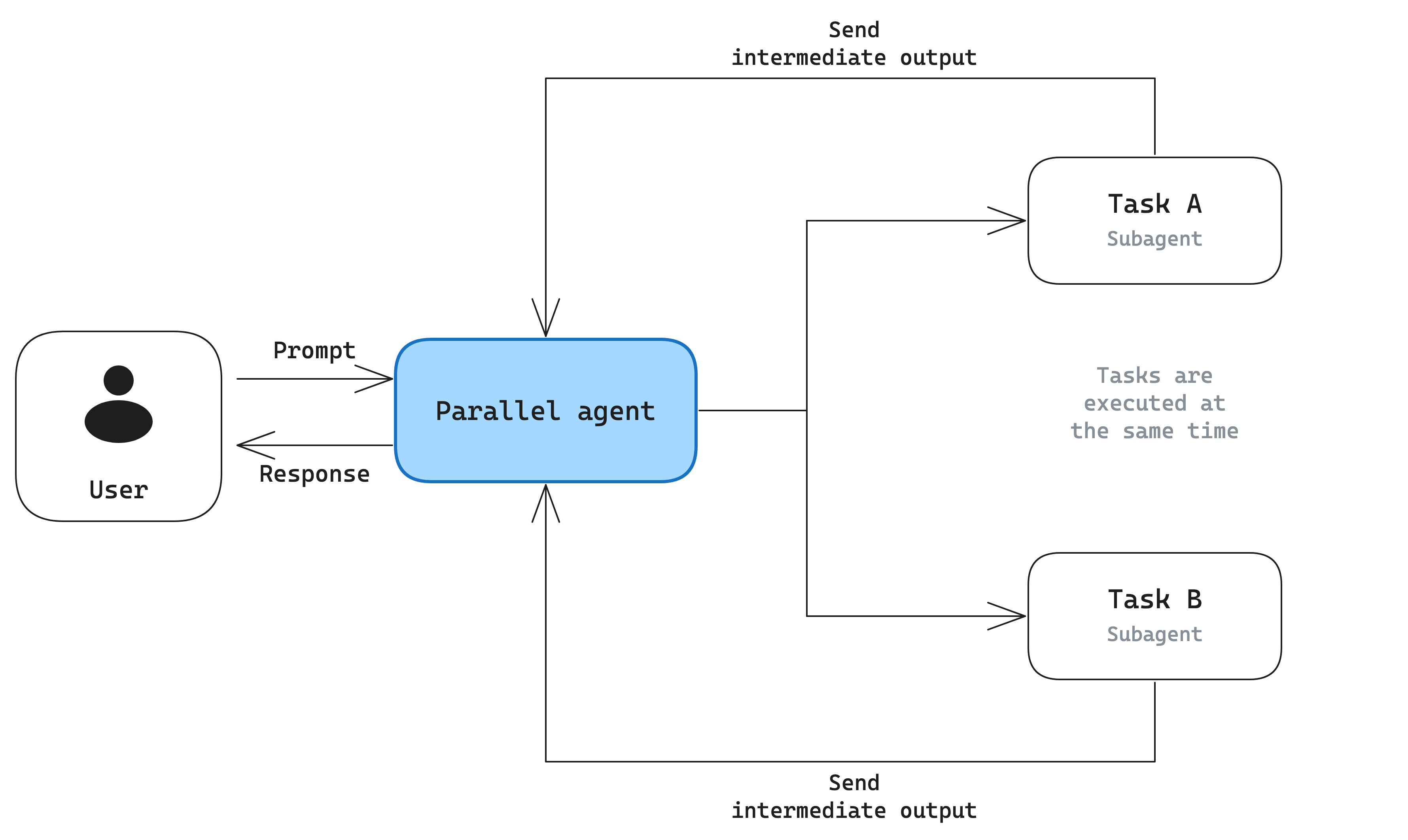
Diagram
Open the interactive version here to pan and zoom.
How it works
Like the sequential pattern, this one uses a parallel workflow agent to manage how and when the other agents run, without consulting an AI model to orchestrate them. The work splits into two phases: a fan-out, where subagents run concurrently, and a gather, where one final step consolidates what came back.
The gather step is where the difficulty lives — see Trade-offs below.
When to use it
Use it when sub-tasks can genuinely execute concurrently, either to cut latency or to collect diverse perspectives at once — gathering data from disparate sources, or evaluating several options simultaneously.
The source’s example: to analyze customer feedback, a parallel agent fans a single feedback entry out to four specialized agents at the same time — a sentiment analysis agent, a keyword extraction agent, a categorization agent, and an urgency detection agent. A final agent gathers those four outputs into a single comprehensive analysis.
From the pattern-comparison guidance, the workload profile is:
- independent tasks that can execute at the same time,
- no need for model orchestration,
- overall latency reduced by running sub-tasks simultaneously.
Trade-offs
Lower overall latency than a sequential approach, because information is gathered from multiple sources at once.
Against that: running multiple agents in parallel increases immediate resource utilization and token consumption, raising operational costs. And the gather step requires complex logic to synthesize results that may conflict with each other, which adds development and maintenance overhead.
Not the same as a coordinator
The coordinator pattern also dispatches work to specialized agents, but it uses a model to decide which agents get the work at runtime. The parallel pattern’s dispatch is hardcoded: the same fan-out happens every time, with no reasoning call spent on the decision.
Footnotes
-
Samantha He, “Choose a design pattern for your agentic AI system”, Google Cloud Architecture Center, last reviewed 2026-05-28. Local copy:
references/google-cloud-agentic-design-patterns.md. ↩