A single-agent system uses an AI model, a defined set of tools, and a comprehensive system prompt to autonomously handle a user request or complete a specific task.1 It is the fundamental agentic pattern — every other pattern here is a response to a limit this one runs into.
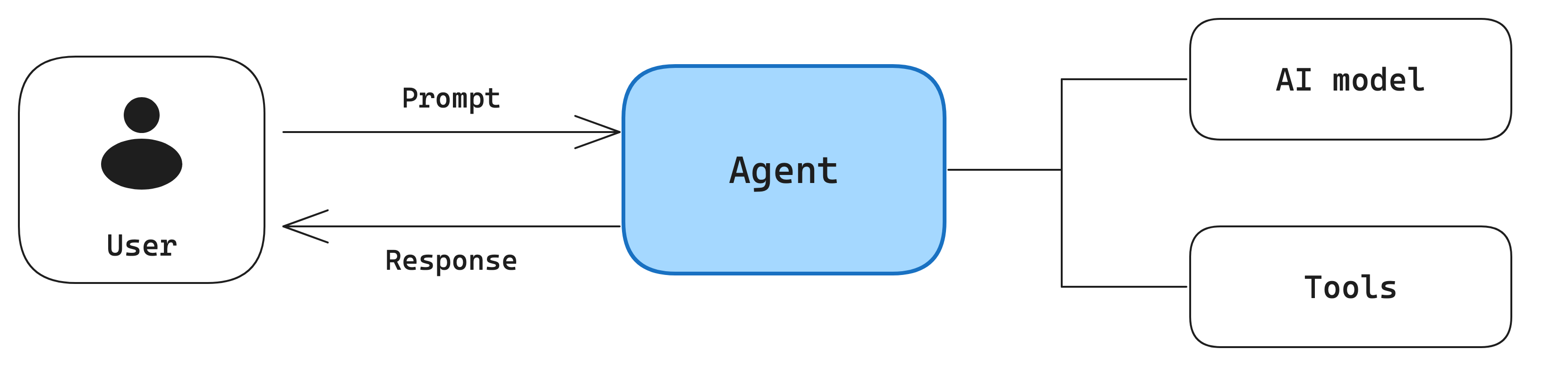
Diagram
Open the interactive version here to pan and zoom.
How it works
The agent relies on the model’s own reasoning to interpret the request, plan a sequence of steps, and decide which tools to use from the defined set. The system prompt is doing more work here than in any other pattern: it shapes behavior by defining the agent’s core task, its persona, its operations, and the specific conditions under which each tool should be used.
This maps onto the three components of a generative agent — foundation model, tools, and reasoning loop — covered in GAIL Module 5.
When to use it
Use it for tasks that need multiple steps and access to external data. A customer support agent that must query a database for an order status, or a research assistant that calls APIs to summarize recent news, both fit. A non-agentic system can’t do either job, because it can’t autonomously use tools or execute a multi-step plan and synthesize a final answer.
It’s also the right place to begin. If you’re early in agent development, start here: a single agent lets you refine core logic, prompt, and tool definitions before adding architectural components that make all three harder to debug.
Where it breaks down
A single agent’s performance degrades as you add tools and as tasks grow more complex. The symptoms the source names are worth memorizing, because they’re how you’ll notice the ceiling:
- increased latency,
- incorrect tool selection or tool use,
- outright failure to complete the task.
Often you can mitigate these by tightening the agent’s reasoning process with a technique like the ReAct pattern. But if the workflow genuinely requires one agent to manage several distinct responsibilities, no amount of prompt refinement will fix it — that’s the signal to move to a multi-agent system, which improves resilience and performance by delegating specific skills to specialized agents.
Trade-offs
Cheapest and simplest of the patterns, with the fewest model calls per request and the least orchestration code to maintain. The cost is a hard ceiling on task complexity and tool count, past which reliability falls off rather than degrading gracefully.
Footnotes
-
Samantha He, “Choose a design pattern for your agentic AI system”, Google Cloud Architecture Center, last reviewed 2026-05-28. Local copy:
references/google-cloud-agentic-design-patterns.md. ↩