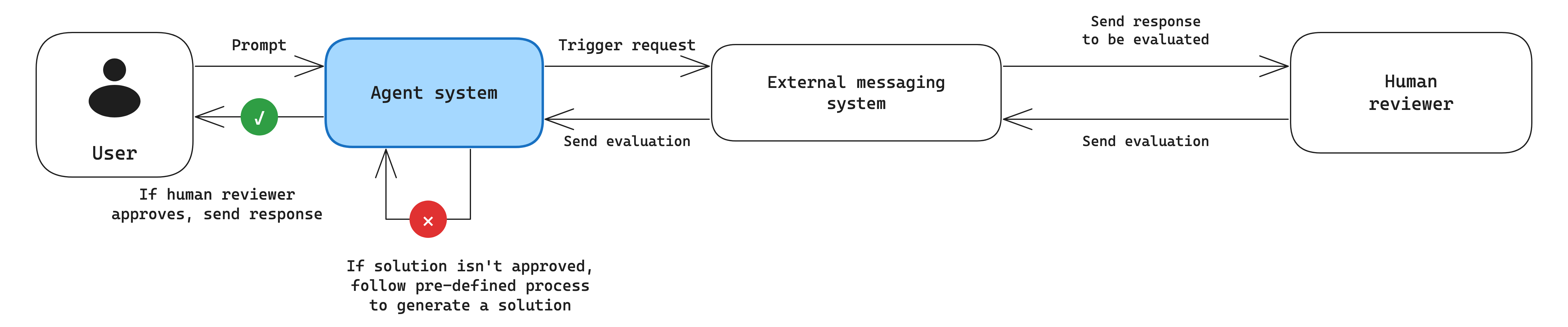
The human-in-the-loop pattern integrates points for human intervention directly into an agent’s workflow.1 At a predefined checkpoint, the agent pauses execution and calls an external system to wait for a person to review its work.
Diagram
Open the interactive version here to pan and zoom.
How it works
The checkpoint is a deliberate suspension of autonomy: the agent stops, hands off, and does not proceed until a person acts. That person can approve a decision, correct an error, or provide input the agent needs before it can continue.
The mechanism is an external system the agent calls out to — which is where the architectural cost of this pattern lives.
When to use it
Use it for tasks requiring human oversight, subjective judgment, or final approval of critical actions — approving a large financial transaction, validating the summary of a sensitive document, or giving subjective feedback on generated creative content.
The source’s example: an agent tasked with anonymizing a patient dataset for research automatically identifies and redacts all protected health information, then pauses at a final checkpoint. It waits for a human compliance officer to manually validate the dataset and approve its release, which helps ensure no sensitive data is exposed.
From the pattern-comparison guidance, the workload profile is a single line: work requiring human supervision because of high-stakes or subjective tasks, which may carry safety, reliability, and compliance requirements.
Trade-offs
Safety and reliability improve, because human judgment is inserted at the decision points where an autonomous mistake would be most costly.
The pattern adds significant architectural complexity, since you have to build and maintain the external system through which that human interaction happens — including whatever queuing, notification, and state persistence a paused workflow needs.
Related
Human-in-the-loop also appears in this wiki as one of the techniques for working around foundation model limitations — content moderation, sensitive applications, and high-risk decisions, applied both before and after generation. See GAIL Module 2. It composes with any other pattern here: a checkpoint can sit inside a sequential pipeline or at the approval step of a coordinator workflow.
Footnotes
-
Samantha He, “Choose a design pattern for your agentic AI system”, Google Cloud Architecture Center, last reviewed 2026-05-28. Local copy:
references/google-cloud-agentic-design-patterns.md. ↩