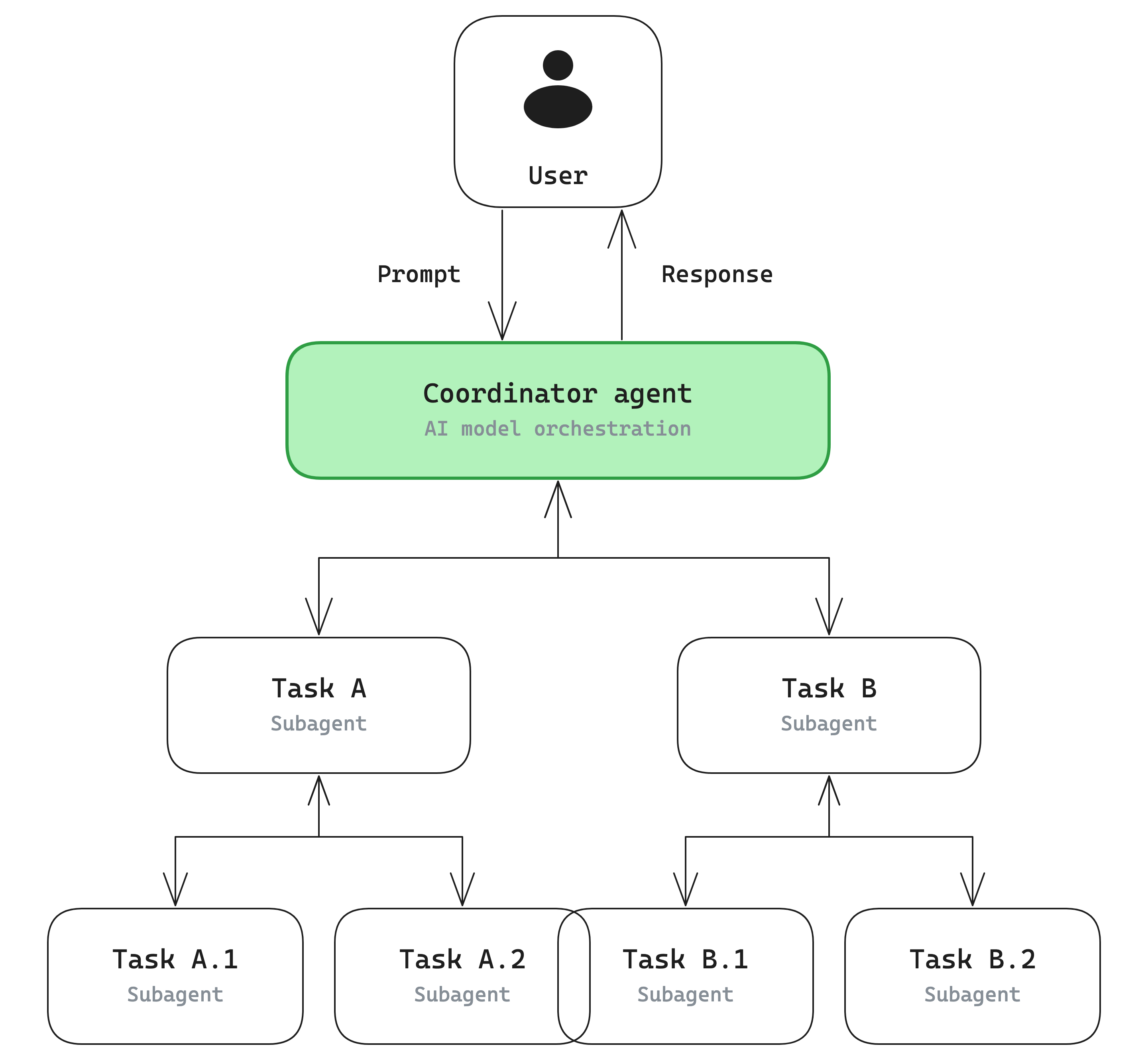
The multi-agent hierarchical task decomposition pattern organizes agents into a multi-level hierarchy to solve complex problems that require extensive planning.1 It is an implementation of the coordinator pattern, applied at more than one level.
Diagram
Open the interactive version here to pan and zoom.
How it works
A top-level parent — the root agent — receives a complex task and is responsible for decomposing it into several smaller, manageable sub-tasks. It delegates each sub-task to a specialized subagent one level down.
That process can repeat through multiple layers, with agents progressively decomposing their assigned tasks until the tasks are small enough to be executed directly by a worker agent at the lowest level. Decomposition, not execution, is what the upper layers actually do.
When to use it
Use it for ambiguous, open-ended problems that require multi-step reasoning — tasks involving research, planning, and synthesis.
The source’s example is a complex research project. A coordinator agent decomposes the high-level goal into tasks like gathering information, analyzing the findings, and synthesizing the final report, then delegates those to specialized subagents — a data gathering agent, an analysis agent, and a report-writing agent — each of which either executes its task or decomposes it further.
From the pattern-comparison guidance, the workload profile is:
- multi-level model orchestration for complex, open-ended, ambiguous tasks,
- a need for comprehensive, high-quality results where decomposing the ambiguity is the primary challenge,
- tolerance for high latency from nested, multi-level decomposition and the many reasoning calls it makes.
Trade-offs
For highly complex and ambiguous problems, systematic decomposition into manageable sub-tasks produces more comprehensive, higher-quality results than simpler patterns can.
The capability is expensive on every axis. The multi-level structure adds considerable architectural complexity, making the system harder to design, debug, and maintain. The layers of delegation and reasoning also produce a high number of model calls, which significantly increases both latency and operational cost relative to other patterns.
Footnotes
-
Samantha He, “Choose a design pattern for your agentic AI system”, Google Cloud Architecture Center, last reviewed 2026-05-28. Local copy:
references/google-cloud-agentic-design-patterns.md. ↩