The multi-agent swarm pattern uses a collaborative, all-to-all communication approach, in which multiple specialized agents work together to iteratively refine a solution to a complex problem.1
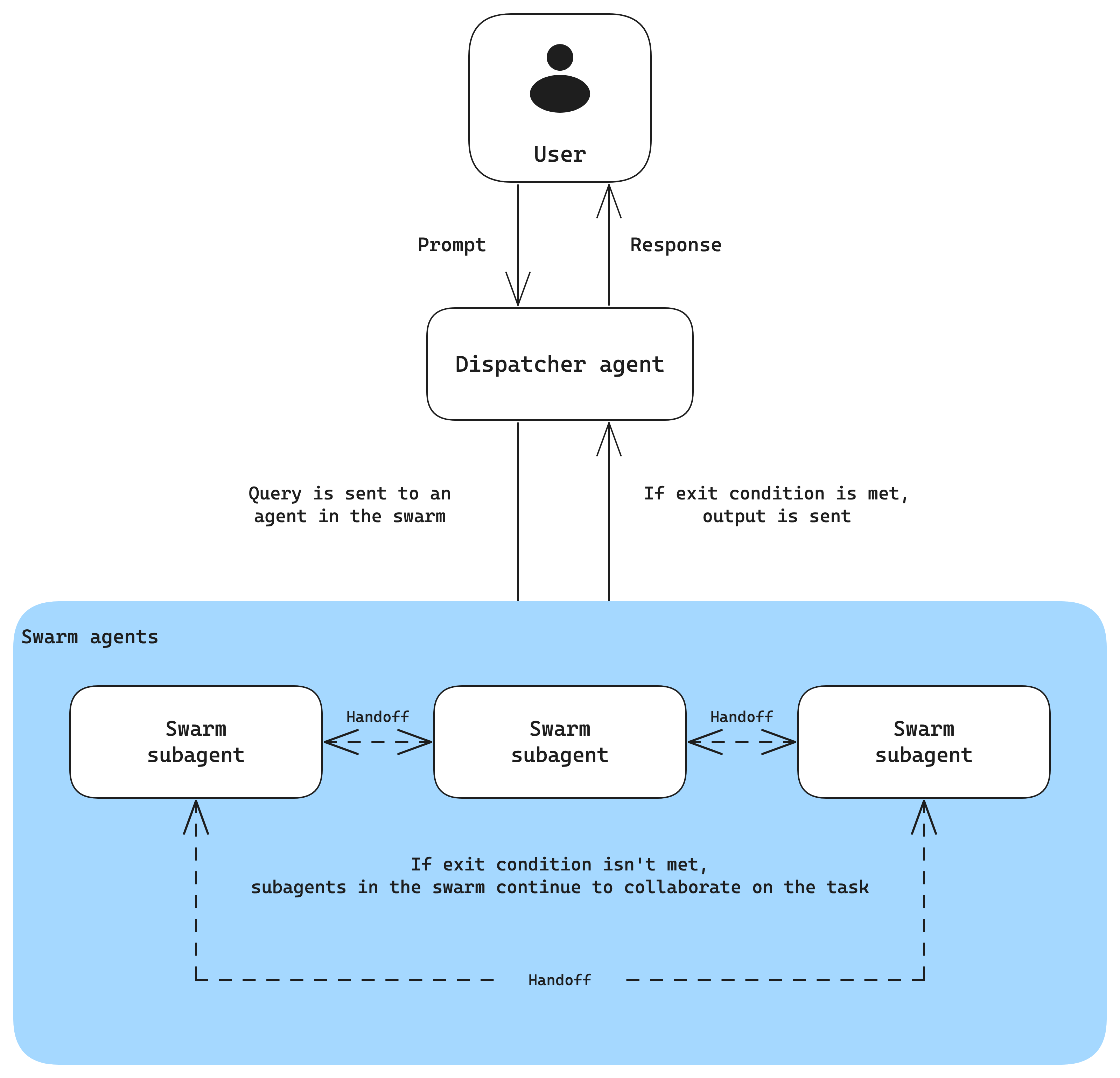
Diagram
Open the interactive version here to pan and zoom.
How it works
A dispatcher agent routes the user’s request into the collaborative group. It interprets the request and determines which agent in the swarm is best suited to begin the task.
From there, every agent can communicate with every other agent. They share findings, critique proposals, and build on each other’s work to iteratively refine a solution. Any agent can hand the task off to another agent it judges better suited to the next step, or return the final response to the user.
No orchestrator, so you need an exit condition
A swarm typically lacks a central supervisor. The dispatcher does not orchestrate the workflow — unlike the coordinator pattern, where a model actively routes each sub-task. The dispatcher only facilitates communication between the swarm’s subagents and the user. (The source’s own wording slips here, describing the return path as going “back to the user through the coordinator agent”; that agent is the dispatcher, which brokers messages rather than directing work.)
Because nothing in the system is steering toward completion, you must define an explicit exit condition. Typically that’s a maximum number of iterations, a time limit, or achieving a specific goal such as reaching consensus.
When to use it
Use it for ambiguous or highly complex problems that benefit from debate and iterative refinement.
The source’s example is designing a new product, involving a market researcher agent, an engineering agent, and a financial modeling agent. They share initial ideas, debate the trade-offs between features and costs, and collectively converge on a final design specification that balances the competing requirements.
From the pattern-comparison guidance, the workload profile is:
- collaborative debate and iterative refinement from multiple specialized agents, on highly complex, open-ended, or ambiguous tasks,
- synthesis of multiple perspectives into a comprehensive or creative solution,
- tolerance for high latency and operational cost from dynamic, all-to-all communication.
Trade-offs
Because it simulates a collaborative team of experts, the swarm can produce exceptionally high-quality and creative solutions.
It is also the most complex and costly multi-agent pattern to implement. Without an agent using a model to orchestrate, the swarm risks unproductive loops or failing to converge on a solution at all. You have to design sophisticated logic to manage intricate inter-agent communication, control the iterative workflow, and absorb the significant cost and latency of a dynamic, multi-turn conversation among several agents.
Footnotes
-
Samantha He, “Choose a design pattern for your agentic AI system”, Google Cloud Architecture Center, last reviewed 2026-05-28. Local copy:
references/google-cloud-agentic-design-patterns.md. ↩