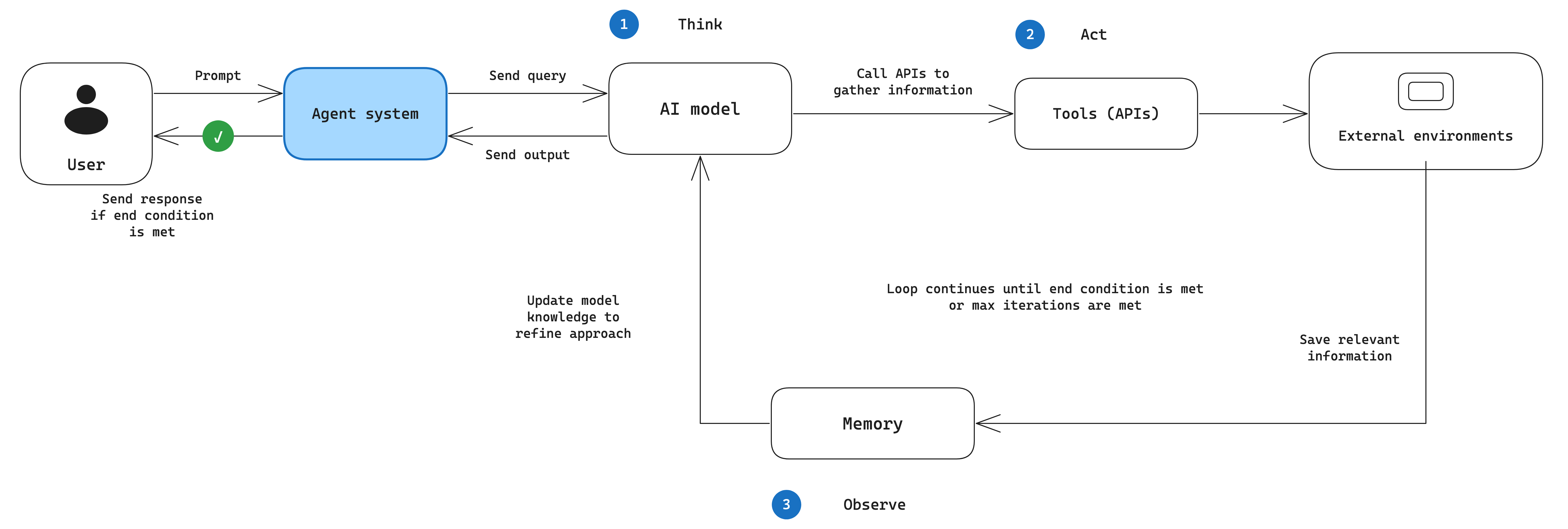
The ReAct (reason and act) pattern has the AI model frame its thought processes and actions as a sequence of natural language interactions.1 The agent operates in an iterative loop of thought, action, and observation until an exit condition is met. It originates in the ReAct paper (Yao et al., 2022).
Diagram
Open the interactive version here to pan and zoom.
The loop
- Thought — the model reasons about the task and decides what to do next, evaluating everything it has gathered so far to determine whether the user’s request has been fully answered.
- Action — based on that reasoning, the model does one of two things. If the task isn’t complete, it selects a tool and forms a query to gather more information. If the task is complete, it formulates the final answer and ends the loop.
- Observation — the model receives the tool’s output and saves the relevant information to memory. Because it accumulates observations, it can build on previous ones, which keeps it from repeating itself or losing context.
The loop terminates when the agent reaches a conclusive answer, hits a preset maximum number of iterations, or encounters an error that prevents it from continuing. This structure is what lets the agent build a plan dynamically, gather evidence, and adjust its approach as it goes.
When to use it
Use it for complex, dynamic tasks that require continuous planning and adaptation.
The source’s example is a robotics agent generating a path from an initial state to a goal state. Thought: reason about the optimal path, optimizing for metrics like time or energy. Action: execute the next step by moving along a calculated path segment. Observation: record the new state of the environment — its own position and any perceived changes. The loop lets the agent honor dynamic constraints such as new obstacles or traffic regulations by constantly updating its plan against new observations, continuing until it reaches its goal or errors out.
From the pattern-comparison guidance, the workload profile is:
- the agent must iteratively reason, act, and observe to build or adapt a plan for complex, open-ended, dynamic tasks,
- a more accurate and thorough result is worth more than low latency.
Trade-offs
A single ReAct agent is simpler and more cost-effective to build and maintain than a full multi-agent system. The model’s thinking also produces a transcript of its reasoning, which helps with debugging — you can see where a run went wrong.
Against that, the iterative multi-step loop raises end-to-end latency compared with a single query, and the agent’s effectiveness depends heavily on the quality of the model’s reasoning. An error or a misleading result from a tool at one observation step propagates forward and can make the final answer wrong.
Where it fits
ReAct is the standard first response when a single agent starts picking the wrong tools or failing to finish tasks — tighten the reasoning process before reaching for more architecture. ReAct and chain-of-thought prompting are also covered from the certification angle in GAIL Module 5, which contrasts ReAct’s external interaction with chain-of-thought’s purely internal reasoning.
Footnotes
-
Samantha He, “Choose a design pattern for your agentic AI system”, Google Cloud Architecture Center, last reviewed 2026-05-28. Local copy:
references/google-cloud-agentic-design-patterns.md. ↩