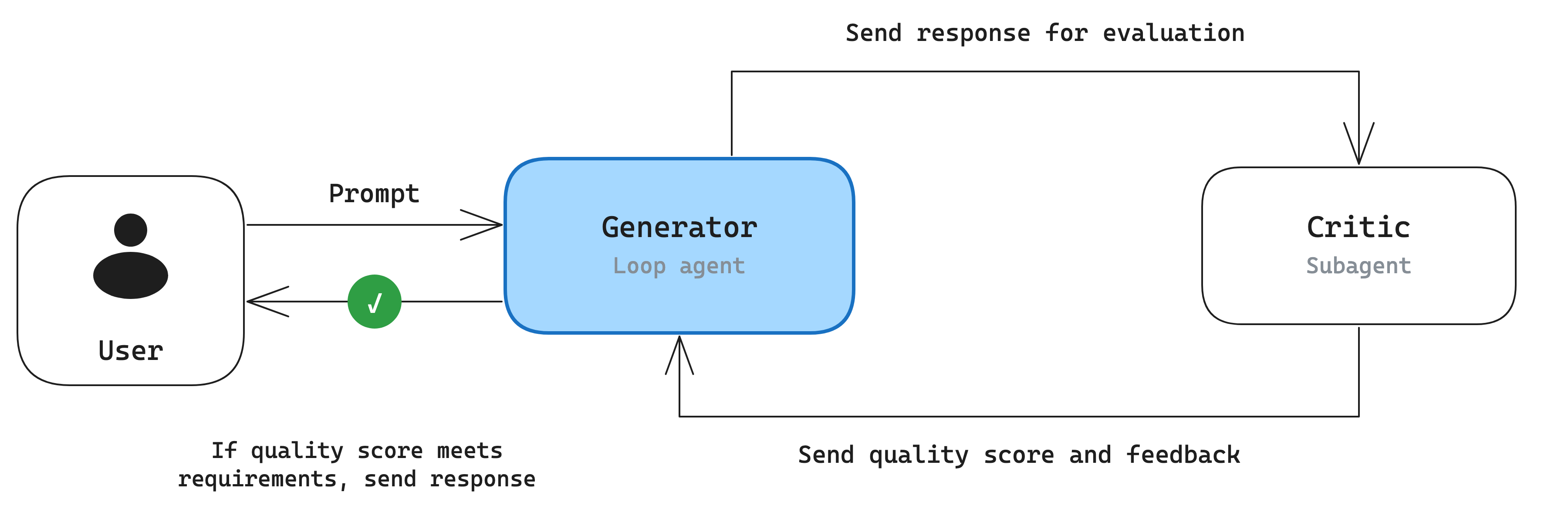
The multi-agent review and critique pattern — also called the generator and critic pattern — improves the quality and reliability of generated content using two specialized agents, typically in a sequential workflow.1 It is an implementation of the loop pattern.
Diagram
Open the interactive version here to pan and zoom.
How it works
A generator agent creates an initial output — a block of code, a summary of a document. A critic agent then evaluates that output against a predefined set of criteria: factual accuracy, adherence to formatting rules, safety guidelines. Based on that evaluation the critic does one of three things:
- approve the content,
- reject it,
- return it to the generator with feedback for revision.
The third branch is what makes this a loop rather than a straight line, and it’s where the cost accumulates.
When to use it
Use it when outputs must be highly accurate, or must conform to strict constraints, before they reach a user or a downstream process.
The source’s example is a code generation workflow: a generator agent writes a function to fulfill a user’s request, and the generated code passes to a critic agent acting as a security auditor. That critic checks the code against a set of constraints — scanning for security vulnerabilities, verifying that it passes all unit tests — before the code is approved for use.
From the pattern-comparison guidance, the workload profile is short: tasks that require a distinct validation step before completion.
Trade-offs
Output quality, accuracy, and reliability improve because verification is a dedicated step performed by an agent with different instructions than the one that produced the work.
That quality assurance costs latency and operational expense directly. The workflow requires at least one additional model call for the critic’s evaluation, and if revision loops are included — content sent back for refinement — both latency and cost accumulate with every iteration.
Compared with iterative refinement
Both are loop implementations and they overlap in practice. The distinction worth holding onto: review and critique is fundamentally a gate, with a separate critic deciding whether work passes, whereas iterative refinement is fundamentally improvement, with agents progressively reworking a result in session state until it’s good enough.
Footnotes
-
Samantha He, “Choose a design pattern for your agentic AI system”, Google Cloud Architecture Center, last reviewed 2026-05-28. Local copy:
references/google-cloud-agentic-design-patterns.md. ↩